Tuesday, 23 December 2014

Musical Instruments from China (Part IV)

Hello guys ;) Here comes to the part 4 of China musical instruments
Okay we let the pictures say
(A picture pays a thousand words right? xD )

Metal (金)


Bianzhong (編鐘) – 16 to 65 bronze bells hung on a rack, struck using poles


Luo (simplified Chinese: 锣; traditional Chinese: 鑼; pinyin: luó) – gong
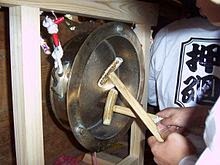
Daluo (大锣) – a large flat gong whose pitch drops when struck with a padded mallet
Fengluo (风锣) – literally "wind gong," a large flat gong played by rolling or striking with a large padded mallet
Xiaoluo (小锣) – a small flat gong whose pitch rises when struck with the side of a flat wooden stick
Yueluo (月锣) – small pitched gong held by a string in the palm of the hand and struck with a small stick; used in Chaozhou music
Jingluo (镜锣) – a small flat gong used in the traditional music of Fujian [3]
Pingluo (平锣) – a flat gong[5]
Kailuluo (开路锣)


Yunluo (simplified Chinese: 云锣; traditional Chinese: 雲鑼) – literally "cloud gongs"; 10 or more small tuned gongs in a frame


Pengling (碰铃; pinyin: pènglíng) – a pair of small bowl-shaped finger cymbals or bells connected by a length of cord, which are struck together


Dangzi (铛子) – a small, round, flat, tuned gong suspended by being tied with silk string in a round metal frame that is mounted on a thin wooden handle; also called dangdang (铛铛)


Yinqing (引磬) – an inverted small bell affixed to the end of a thin wooden handlephoto


Chun (錞; pinyin: chún) – ancient bellphoto
Weichun (帷錞) – ancient hanging bell


Bronze drum (铜鼓)

Musical Instruments from China (Part III)

Hey guys :) we are now on introducing China musical instruments part 3!
Wuhoo! Ready to see these awesome instruments?
Here we go!

Alright, today we going to take a look on musical instruments in the categories of stone, clay and gourd (hope you guys still remember we have 8 categories which are silk, bamboo, wood, stone, metal, clay, gourd and hide)

Stone (石)


The "stone" category comprises various forms of stone chimes.


Bianqing (simplified Chinese: 编磬; traditional Chinese: 編磬; pinyin: biānqìng) – a rack of stone tablets that are hung by ropes from a wooden frame and struck using a mallet


Sounding stone or Qing (磬)


Clay (土)


Fou (Chinese: 缶; pinyin: fǒu) – clay pot played as a percussion instrument

Gourd (匏)


Sheng (Chinese: 笙; pinyin: shēng) – free reed mouth organ consisting of varying number of bamboo pipes inserted into a metal (formerly gourd or hardwood) chamber with finger holes
Baosheng (抱笙) – larger version of the Sheng


Hulusi (simplified Chinese: 葫芦丝; traditional Chinese: 葫蘆絲; pinyin: húlúsī) – free-reed wind instrument with three bamboo pipes which pass through a gourd wind chest; one pipe has finger holes and the other two are drone pipes; used primarily in Yunnan province


Hulusheng (simplified Chinese: 葫芦笙; traditional Chinese: 葫蘆笙; pinyin: húlúshēng) – free-reed mouth organ with a gourd wind chest; used primarily in Yunnan province

Musical Instruments from China (Part II)

Since last night we talk about Musical Instruments from China (Part I), today I introducing musical instruments in the categories of bamboo and wood

Bamboo (竹)


A half-section of the Song Dynasty (960–1279) version of the Night Revels of Han Xizai, original by Gu Hongzhong;[2] the female musicians in the center of the image are playing transverse bamboo flutes and guan, and the male musician is playing a wooden clapper called paiban.


Dizi, also known as di (笛) or hengdi (橫笛), and has varieties including qudi (曲笛) and bangdi (梆笛).[3]


A Bawu in the key of F[4]


Bamboo mainly refers to woodwind instruments, which includes

Flutes

Dizi (笛子) – transverse bamboo flute with buzzing membrane


 (Blowing hole)
Xiao (簫) – bamboo flute not unlike the recorder


Oboes


Guan (Chinese: 管; pinyin: guǎn) – cylindrical double reed wind instrument made of either hardwood (Northern China) or bamboo (Cantonese); the northern version is also called guanzi (管子) or bili (traditional: 篳篥; simplified: 筚篥), the Cantonese version is also called houguan (喉管), and the Taiwanese version is called 鸭母哒仔, 鴨母笛, or Taiwan guan (台湾管)


Suona (simplified Chinese: 唢呐; traditional Chinese: 嗩吶) – double-reed wind instrument with a flaring metal bell; also called haidi (海笛)

Free reed pipes


( closeup to the mouthpiece)


Bawu (simplified Chinese: 巴乌; traditional Chinese: 巴烏; pinyin: bāwū) – side-blown free reed pipe with finger holes


Wood (木)


Most wood instruments are of the ancient variety:


Muyu (simplified Chinese: 木鱼; traditional Chinese: 木魚; pinyin: mùyú) – a rounded woodblock carved in the shape of a fish, struck with a wooden stick; often used in Buddhist chanting

This is a set of muyus or Chinese wooden slit drums. The sound produced is affected by the instrument’s size, type of wood, and how hollow it is. 


(some kind like the Japanese musical instrument)


Paiban (拍板) – a clapper made from several flat pieces of wood; also called bǎn (板), tánbǎn (檀板), mùbǎn (木板), or shūbǎn (书板); when used together with a drum the two instruments are referred to collectively as guban (鼓板)
Zhuban (竹板, a clapper made from two pieces of bamboo)
Chiban (尺板)

Musical Intruments from China (Part I)

The introduction of  Musical Instruments from Japan still on my mind
But we have to move on to others country to keep our mind wide opened xD

Chinese musical instruments were traditionally classified into 8 categories known as bayin (八音). The eight categories are: silk, bamboo, wood, stone, metal, clay, gourd and hide. There are other instruments which may not fit these classifications. This is one of the first musical classifications ever.

Silk (絲)


Silk instruments are mostly stringed instruments (including those that are plucked, bowed, and struck). Since ancient times the Chinese have used twisted silk for strings, though today metal or nylon are more frequently used. Instruments in the silk category include:

Plucked


Guqin (Chinese: 古琴; pinyin: gǔqín) – 7-stringed zither


Guzheng (古箏) – 16–26 stringed zither with movable bridges


Pipa (琵琶) – pear-shaped fretted lute with 4 or 5 strings


Sanxian (三弦) – plucked lute with body covered with snakeskin and long fretless neck


Ruan (Chinese: 阮; pinyin: ruǎn) – moon-shaped lute in five sizes: gaoyin-, xiao-, zhong-, da-, and diyin-; sometimes called ruanqin (阮琴)


Liuqin (柳琴) – small plucked, fretted lute with a pear-shaped body and four strings


Yueqin (月琴) – plucked lute with a wooden body, a short fretted neck, and four strings tuned in pairs


Bowed 


Huqin (胡琴) – family of vertical fiddles


Erhu (二胡) – two-stringed fiddle
Zhonghu (中胡) – two-stringed fiddle, lower pitch than erhu
Gaohu (高胡) – two-stringed fiddle, higher pitch than erhu; also called yuehu (粤胡)
Banhu (板胡) – two-stringed fiddle with a coconut resonator and wooden face, used primarily in northern China
Jinghu (京胡) – two-stringed fiddle, very high pitched, used mainly for Beijing opera
Jing erhu (京二胡) – erhu used in Beijing opera
Erxian (二弦) – two-stringed fiddle, used in Cantonese, Chaozhou, and nanguan music
Tiqin (提琴) – two-stringed fiddle, used in kunqu, Chaozhou, Cantonese, Fujian, and Taiwanese music


Yehu (椰胡) – two-stringed fiddle with coconut body, used primarily in Cantonese and Chaozhou music


Sihu (四胡) – four-stringed fiddle with strings tuned in pairs


Dihu (低胡) – low pitched two-stringed fiddles in the erhu family, in three sizes:
Xiaodihu (小低胡) – small dihu, tuned one octave below the erhu
Zhongdihu (中低胡) – medium dihu, tuned one octave below the zhonghu
Dadihu (大低胡) – large dihu, tuned two octaves below the erhu
Dahu (大胡) – another name for the xiaodihu


Matouqin (馬頭琴) – (Mongolian: morin khuur) – Mongolian two-stringed "horsehead fiddle"


Struck


  Yangqin – a Chinese dulcimer.
Well, tonight we stop at here, goodnight and sweet dreams ;)

Musical Instruments from Japan

Hello guys :) we meet again ;)
I was introducing Musical Instruments from Great Britain and Ireland
Today we will move to Asia and take a lot on Asians' musical intrsuments

Percussion


Hyōshigi (拍子木) — wooden or bamboo clappers

 Mokugyo (木魚) — woodblock carved in the shape of a fish, struck with a wooden stick; often used in Buddhist chanting Shōko


Bin-sasara (編木, 板ささら; also spelled bin-zasara) — clapper made from wooden slats connected by a rope or cord


Kane (鉦) — small flat gong


Taiko (太鼓), literally "great drum" 

Strings

Biwa
Koto (琴, 箏) — long zither
 Kugo (箜篌) — an angled harp used in ancient times and recently revived
 Sanshin (三線) — three-string banjo from Okinawa
Tonkori (トンコリ) — plucked instrument used by the Ainu of Hokkaidō

Bowed

 
Kokyū - bowed lute with three (or, more rarely, four) strings and a skin-covered body

Wind

Flutes

Japanese flutes are called Fue. there are eight different flutes

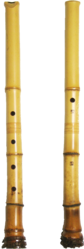
Root end

Finger hole

Hocchiku (法竹) — vertical bamboo flute


Kagurabue (神楽笛) — transverse bamboo flute used for mi-kagura (御神楽, Shinto ritual music)


 Komabue (高麗笛) — transverse bamboo flute used for komagaku; similar to the ryūteki


Shakuhachi (尺八) — vertical bamboo flute used for Zen meditation

 Shinobue (篠笛) — transverse folk bamboo flute


Tsuchibue (hiragana: つちぶえ; kanji: 土笛; literally "earthen flute") — globular flute made from clay

Horns


Horagai (法螺貝) — seashell horn; also called jinkai (陣貝)

Here's for today ;) see you ;)